Guide
How to Choose a Graphic Apparel Manufacturer for Your Brand
A practical checklist for picking the right manufacturing partner for your brand.
Share a few details and we’ll reach out to set up a call.
Updated November 2026
Picking a manufacturer is one of the biggest decisions a growing apparel brand makes. The right partner keeps quality consistent and deliveries on time. The wrong one shows up as late launches, reprints and margin you did not plan to lose. This checklist covers what to evaluate, what to ask and how to tell a real fit from a good sales pitch.
We are a manufacturer ourselves, so we will use Premium Shirts as an example where it helps, and we will also say plainly where we are not the right choice.
1. Vertical manufacturer or broker?
This is the first question to settle, because it shapes everything else.
- A broker or sourcing agent takes your order and places it with one or more factories. Brokers can be useful for range and flexibility, but every handoff between vendors is a place for delays, quality drift and finger-pointing.
- A vertically integrated manufacturer controls the production stages itself. The more stages it owns, the fewer handoffs there are.
Ask stage by stage what is done in-house: yarn and fabric, dyeing, cutting, sewing, printing, finishing and packing. "We manage it" is not the same as "we make it."
Premium spins and knits its own fabric and handles cut and sew, graphics and print, finishing, packing and shipping in its own facilities.
2. Product focus: do they make what you sell?
A manufacturer that is excellent at knit tees may not be the right partner for jackets or woven shirts. Specialization usually helps quality and price.
Premium focuses on knits: tees, long sleeves and fleece. It does not make outerwear, polos or woven shirts, and it does not sell blank apparel on its own. If your line depends on those categories, you will need another partner for them.
3. Minimums that match your volume
Minimums usually apply at three levels: per program or year, per graphic and per colorway. Make sure all three fit your plan, not just the headline number.
For reference, Premium's minimums are 2,500 units a year, 300 units per graphic and 150 units per colorway. Custom fits start around 25,000 units a year and custom fabrics around 100,000.
If you are under 2,500 units a year, a full-package manufacturer is likely early for you. Print-on-demand, small-batch or blank suppliers are a better fit, and Premium's partner directory lists some.
4. Quality standards you can verify
"High quality" means nothing without a standard behind it. Ask:
- What inspection standard do you use? AQL 2.5 is a widely used benchmark for apparel. Premium inspects every order to AQL 2.5.
- What is your QA pass rate? Premium reports 98%+.
- Do you test against a restricted substances list? Ask specifically about PFAS. Premium tests inputs against an RSL and is PFAS-free.
- Do you do performance testing? Shrinkage, colorfastness and similar tests protect you from returns.
5. Social compliance and sustainability
Retail partners increasingly ask for proof of responsible production. Look for:
- Sedex SMETA audits for labor and ethical standards
- Better Cotton (BCI) sourcing
- Higg Index tracking or reporting
- CTPAT certification if goods cross into the US, for smoother customs clearance
Premium holds all of these. Ask any manufacturer for current audit documentation, not just a logo on a website. Ask us for ours.
6. Sampling and development
How a manufacturer handles development tells you a lot about how it will handle production.
- Will they approve lab dips, strike-offs and samples with you before bulk?
- Do you need a tech pack, or will they build one?
- Is design and development an extra fee or part of the unit price?
- Can you see fabric and print quality before committing?
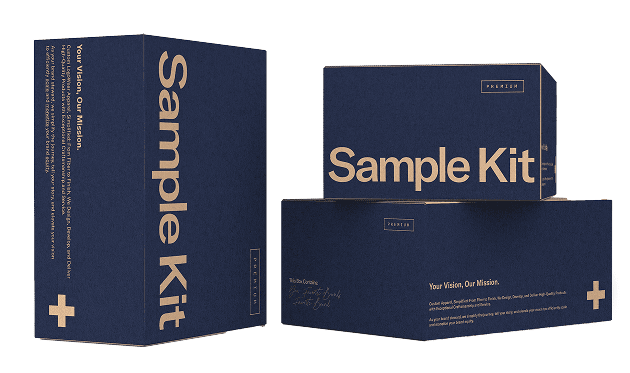
At Premium, every lab dip, strike-off and sample is approved by the brand before bulk, you do not need a tech pack to start, and design and development are included in the unit price. Brands can request a sample kit of core tees and fleece before planning a program.
7. Private label trims and packaging
If you sell at retail, the garment should look like your product, not the factory's. Confirm the manufacturer can supply:
- Custom neck labels with country of origin
- Care and content labels
- Custom hang tags
- Individual poly bagging
- Retail-ready packaging
Also confirm that nothing ships with the manufacturer's name on it. At Premium, every program ships under the customer's brand.
8. Pricing, inclusions and FOB terms
Unit prices are only comparable when you know what they include and where they stop.
- Inclusions: Is design, embellishment, labeling, hang tags and packaging in the price?
- FOB terms: FOB tells you the point where freight responsibility transfers to you. A price FOB overseas port and a price FOB US border are very different numbers once freight and time are added.
Premium's unit price is all-in (design, embellishment, labels, hang tag, poly bag and shipping to Laredo) and quoted FOB Laredo, TX. A typical first run is 2,500 units of a core tee at about $9.50 a unit, as an estimate. Every program is quoted on its own styles, decoration and volume. You can model numbers with the pricing calculator.
9. Lead times and delivery record
Ask for typical lead times and what drives them, then ask for the on-time delivery rate. A short lead time is only valuable if it is reliable.
Premium works on 30, 60 or 90-day timelines from its factory in Lerma, Mexico, and reports 99%+ on-time delivery.
10. Track record with brands like yours
Ask which brands in your category the manufacturer has worked with, and ask to see the work. Premium has built programs for brands across action sports, outdoor, streetwear, workwear, golf and more; examples are on its projects page.
Quick checklist
- In-house production, stage by stage
- Makes the product categories you sell
- Minimums fit per program, graphic and colorway
- AQL 2.5 inspection and a stated QA pass rate
- RSL and PFAS testing
- SMETA, BCI, Higg and CTPAT documentation
- Sampling approvals before bulk
- Full private label trims and packaging
- Clear inclusions and FOB terms
- Verified on-time delivery rate
- Relevant brand references
FAQ
What is the difference between an apparel manufacturer and a broker?
A broker places your order with other factories. A vertically integrated manufacturer runs the production stages itself, which means fewer handoffs and more control over quality and timing.
What does AQL 2.5 mean in apparel?
AQL (Acceptable Quality Limit) is a sampling standard for inspections. AQL 2.5 is a common benchmark for apparel orders. Premium Shirts inspects every order to AQL 2.5.
What is SMETA certification?
SMETA is Sedex's audit methodology for labor, health and safety, environmental and business ethics standards. Premium Shirts is Sedex SMETA audited.
What minimum order should I expect from a graphic apparel manufacturer?
It varies. Premium Shirts programs start at 2,500 units a year, with 300 units per graphic and 150 units per colorway.
Do I need a tech pack before contacting a manufacturer?
Not always. Premium's design and development team builds the specs with you.
See if Premium is a fit
If you sell graphic tees, long sleeves or fleece and run 2,500 or more units a year, we are glad to walk through your plan. Book a 30-minute intro call or request pricing and a sample kit.